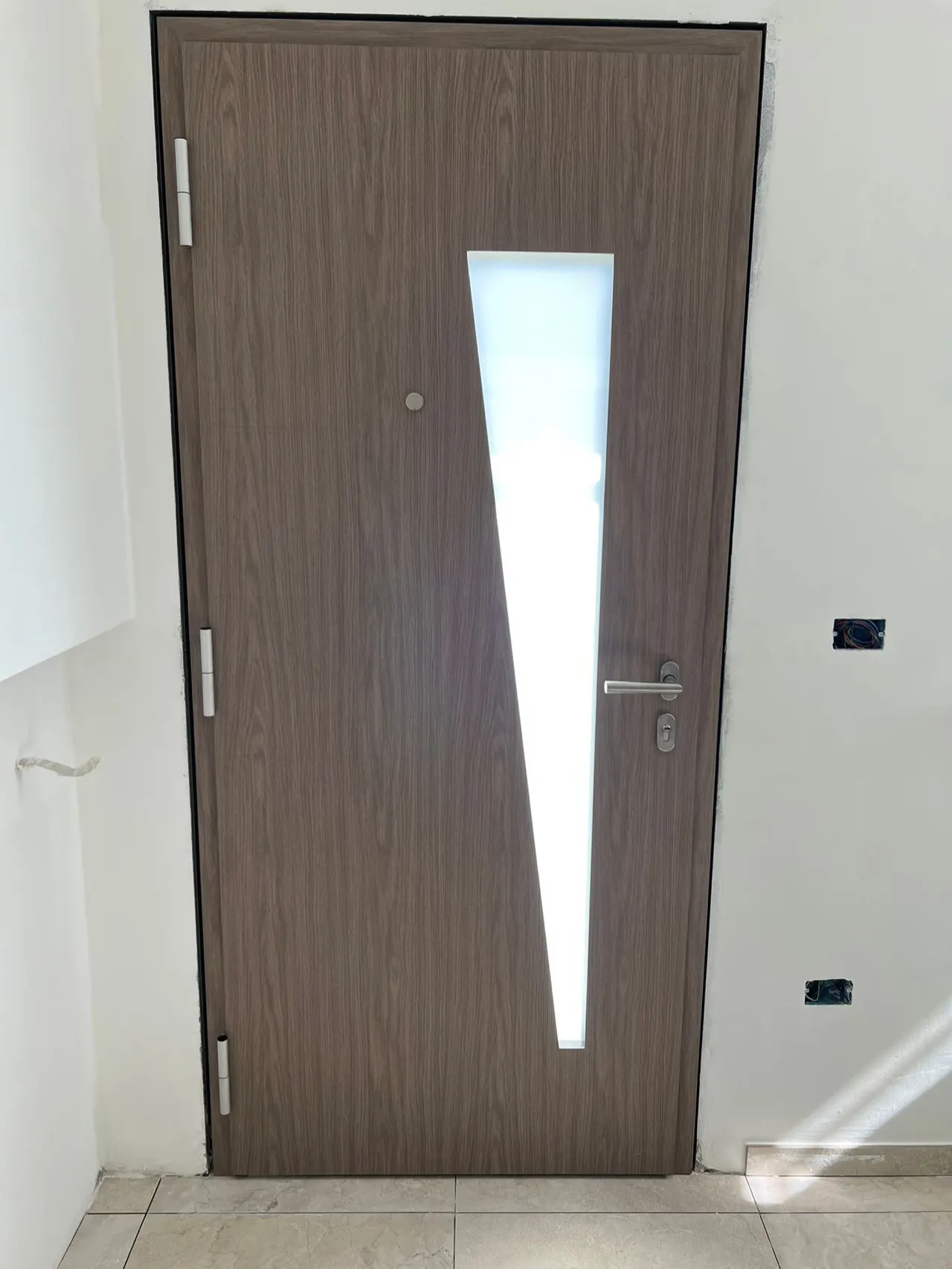
Security front door with a wood-effect panel and a glazed slot

PONZIO security front doors

Made-to-measure security doors, in the right class

We choose the burglar resistance class together, looking at where you live and how people get in. Free site visit between the Teramo coast and the Piceno area.

4,8 on Google, 30 reviews In Martinsicuro since 1990 Site visit and quote, both free

The moment you decide

The front door has been telling you for a while

In the evening you check twice whether you locked up, and sometimes you come back up the stairs to be sure.

It is the door of thirty years ago: one lock, a panel that has warped, a key that has to be coaxed.

In winter a draught comes from the entrance that the radiator in the hallway cannot cover.

A security door answers all three, but only if it is the right one. How long it resists, how well it insulates and how long it lasts do not depend on the word 'security': they depend on the certified class and on how the door is fixed to the wall.

What you are buying

Three concrete things, before the catalogues

A security front door is not an object that is either there or not. It is a measured performance, and you choose what level you need.

01

What you are buying is time

Whoever forces a door is in a hurry and wants to be quiet. Each burglar resistance class corresponds to minutes of resistance measured in a laboratory with specific tools: the more minutes it takes, the more likely whoever tries gives up and goes elsewhere.

Six classes, from 1 to 6, under EN 1627

02

On an entrance it insulates like a good window

A front door that opens to the outside also works against cold, wind and rain. An insulated panel, gaskets all the way round and a thermal break on the frame are the difference between a warm entrance and a funnel.

Insulated panel and thermal-break frame

03

The whole counts, not the strongest part

The class does not belong to the lock or to the leaf. The whole door is certified, frame included, tested as it is fitted in a home. Hinges, deadbolts, cylinder and fixings are all part of the mark.

Leaf, frame, lock and hinges tested together

How security is measured

'Security' is not an adjective, it is a class

The European standard EN 1627 divides burglar resistant doors into six classes, from 1 to 6. It is not a marketing scale: each class describes a type of attack, a precise list of tools and a resistance time the door has to withstand while, in a laboratory, someone really tries to open it.

There are three tests: a static load, a dynamic impact and a manual break-in attempt with the tools set for that class. Whatever passes all three gets the classification. And it applies to the whole: leaf, frame, hinges, lock and cylinder, tested assembled as they will then be fitted.

That is why the first question we ask is not which door you want, but where you live and how people get in. A second floor with the building's entrance door locked and an isolated house backing onto fields do not need the same class.

Security front door in light oak with a side light

EN 1627

The six classes, and who really needs them

Class 1, bodily force

It resists physical force and nothing else: shoulder charges, kicks, attempts to lift or wrench the leaf. No tools are involved, so no resistance time. It only makes sense where getting there is already hard, for instance a high floor with nothing to climb on.

Class 2, the screwdriver

The opportunistic attempt, with simple tools: screwdriver, pliers, wedges. The door has to hold for three minutes. It is the reasonable minimum for a flat in a block, where the building's entrance door already filters who comes in.

Class 3, the crowbar

Here the attack uses a second screwdriver and a real lever. Five minutes of resistance. It is the class that makes sense on a ground-floor entrance, on a detached house and on any door facing the street or a garden.

Class 4, impact and cutting

Hammer, chisel, axe, saw and cordless drill come in. Ten minutes. You choose it when the house is isolated, when it is left empty for long periods or when there is nobody around to hear the noise.

Class 5, power tools

Drill, jigsaw and angle grinder with a small disc. Fifteen minutes. We are already outside the ordinary home: it is the level for stores, warehouses and businesses with goods inside.

Class 6, the long attack

Powerful power tools and a large disc, twenty minutes of resistance. It is the level of strongrooms and vaults. On a house it has no practical sense, and nobody serious will offer it to you.

Security front door of a house, open from outside

The installation

The wall decides the class too

A door certified in class 3 but badly fixed goes back to being an ordinary door. The subframe has to be anchored into the masonry at the points and in the numbers set by the manufacturer, and before that you have to look at what kind of wall it is. With us, whoever fits is the same person who came to measure, so they have already seen the wall.

How it is dressed

The security is inside, the panel is chosen outside

The security structure is the same. What you see are the two panels, outer and inner, and they are chosen separately: outside, one that copes with sun and rain; inside, one matched to the doors of the house.

Oak-effect security front door with a transom and a glazed side light
Wood effect Oak and walnut are the most requested finishes here, with the grain carrying on across the transom and the side lights.
Walnut-effect security front door with a satin glass insert
With a glass insert Burglar resistant glass brings light into the entrance without lowering the class, provided it is certified together with the door.
Bronze solid-colour security front door with a vertical pull handle
Solid colour Lacquered or metal effect, with a vertical pull handle. The panel design changes, the structure underneath stays the same.

The quote

What changes the price of a security front door

Two doors that look related from outside can cost very different amounts, and the items that shift the total are always the same. The burglar resistance class, which is the first decision and counts for more than all the others. The opening: a single leaf in a standard hole is one thing; double leaf, transom and side lights are extra elements to build. The panels, outer and inner, with different finishes and thicknesses. The glass, if there is any, which has to be certified burglar resistant. The lock and the cylinder, where the difference between a basic cylinder and one protected against drilling and pulling is real.

Then there is the fitting, which varies a lot depending on whether the existing subframe can be reused or has to be demolished and made good. That is why we do not give figures on the phone: without having seen the opening it would be an invented number. After the site visit, on the other hand, the price written on the quote is the final one, with every item named so you can compare it line by line with the others.

Walnut-effect security front door with transom and glazed side light, seen from inside

How we work

Four steps, no surprises

Free site visit

We measure the opening and look at the rest: floor, aspect, the building's entrance door, nearby windows, type of masonry. Out of that comes the class that makes sense, not the one that costs most.

Written quote

Class, panels, glass, lock, cylinder and fitting: every item with its price beside it. We go through it line by line before you sign.

Order and fitting

We prepare everything to the measurements taken and fit it ourselves, with the fixings set for that class. We cover up, clean up and take the old door away.

Keys and support

We try the locking together and explain the lock to you. Many have a builder's key: the first time you turn the final one, the temporary keys stop working. If the leaf needs adjusting over time, we come back.

Tax deduction

On a security door, part of the cost comes back

Installing security or reinforced doors falls among the works to prevent unlawful acts by third parties, provided for by the Italian building-stock recovery rules. If the front door separates the home from the outside and improves insulation, it may also fall under energy saving works.

10 yearsover which the deduction is recovered
Two routesanti-burglary or energy saving
Bank transferreference-bearing, with the payment reference and tax codes
How the tax credit works

Rates and ceilings change every year with the Italian budget law and differ between a main and a second home. The two routes cannot be combined on the same spend. The dedicated page has the current figures.

Front doors

Entrances we have fitted, and systems we work with

The first images are our own jobs here in the area. The others are catalogue photos of the systems we fit, to give you an idea before the site visit.

4,8 30 reviews on Google

People who trusted us with their front door

Reviews published on the Diva Infissi Google listing, reproduced here in full.

The reviews are shown in Italian, exactly as they were written on Google. We do not translate what our customers said.

Roberto Picciuto 6 Giugno 2025

IL TOP, DI MEGLIO NON C'È, SUPER CONSIGLIATO, Qualità cortesia e prezzi giusti

Verified review on Google
Alexia Neziri 5 Giugno 2025

I migliori, hanno svolto un lavoro impeccabile, cordiali e precisi in tutto! Lavoro di qualità im tempi ottimali! Grazie davvero

Verified review on Google
Francesca D'Angelo 5 Giugno 2025

Esperienza e professionalità prodotti di ottima qualità. Consigliatissimo.

Verified review on Google
arturix 5 Giugno 2025

ottimo prodotto , prezzo giusto , persone cordiali e molto professionali nella scelta del prodotto e importantissimo presenti nel post vendita !consigliatissimi

Verified review on Google
Ilaria Vallese 5 Giugno 2025

Ho contattato la Diva Infissi per la sostituzione degli infissi di casa e sono rimasta molto soddisfatta. Il team è stato puntuale, professionale e preciso in ogni fase del lavoro, dal sopralluogo alla posa finale. I nuovi infissi sono di ottima qualità, hanno migliorato isolamento termico e acustico, e l’estetica della casa ne ha guadagnato. Un ringraziamento particolare al titolare sempre disponibile e attento alle richieste. Consiglio vivamente quest’azienda a chi cerca affidabilità, competenza e materiali di alto livello.

Verified review on Google

Why choose us

The questions you are asking yourself, and our answer

Who comes to fit it?

Our own fitters, not an outside crew. Whoever takes the measurements is whoever installs, and on a security door that counts double: the fixing is half the security.

Will you recommend the most expensive class?

No. On a second floor with the building's entrance door locked you need a lower class than on an isolated house, and we have no reason to tell you otherwise. The class is chosen on site, looking at the ways in.

And if it does not close properly a year later?

We come back and adjust it. We have been at Via dell'Industria 10 in Martinsicuro since 1990, we do not disappear once the invoice is paid.

Can the price change along the way?

No. After the site visit the quote is the quote. If the opening hides extra work we find it beforehand, not halfway through the job.

Can I see it in person?

Yes, at our premises in Martinsicuro. Opening and closing a security leaf by hand is the quickest way to understand the difference between two quotes that look alike on paper.

Do you do the rest as well?

Yes: uPVC and aluminium windows, interior doors, shutters, insect screens, awnings. One person to deal with for everything that closes your home.

Frequent questions

What people choosing a security door ask

These are the questions that come up most often, on the phone and on Google.

What is the difference between a security door and a security front door?

For the standard, none: the scale of burglar resistance classes is the same. The difference is in the use. A security door is the one to a flat, opening onto a landing, that is, onto an internal, dry space. A security front door is the one opening directly to the outside, the entrance of a detached or independent house.

What changes is what it has to be able to do. An external front door takes sun, rain and wind, so it needs weather gaskets, a thermal break on the frame, panels made to live outdoors and a threshold that does not let water through. A flat door can do without all that and concentrate on security and sound insulation.

What is the difference between class 3 and class 4 of a security door?

The test tools and the minutes change. In class 3 the attack uses a second screwdriver and a crowbar, that is, a real lever, and the door has to hold for five minutes. In class 4 impact and cutting tools come in, hammer, chisel, axe, saw and cordless drill, and the time goes up to ten minutes.

In practice class 3 covers a ground-floor entrance, a detached house, a door facing the street or a garden well. Class 4 makes sense when the house is isolated, is left empty for long periods or has no neighbours who might hear. Above 4 you leave the home and enter the world of businesses and warehouses.

What is the difference between a security door and an 'armoured' door?

None, if you look at the standard. EN 1627 knows only the six burglar resistance classes, from 1 to 6. 'Armoured' is a commercial name, not a certified level: it usually indicates a heavier structure, with thicker sheet or extra reinforcement, but there is no test that defines it.

When you compare two offers, forget the adjectives and look at the declared class and the document that certifies it. Check as well that it refers to the complete door with its frame and not to a single component.

Can an external security front door have glass?

Yes, and the class is not lost if the glass is the prescribed one. On security elements you use burglar resistant glass certified to EN 356, laminated with several sheets and films: for a class 3 door, for instance, the standard asks for P5A glass. The glazed part has to be tested together with the door, otherwise the class written on the certificate no longer applies.

Glass is at its best in front doors with a transom and side lights, which on independent houses are the most common choice: the entrance stays bright and with satin glass you cannot see in from outside. It costs more than a solid panel and is one of the items that shift the quote most.

How much does a made-to-measure security front door cost?

There is no single price, and anyone who gives you one over the phone without having seen the opening is giving you a bait number. Five items shift the total: the burglar resistance class, the size and shape of the opening, because double leaf, transom and side lights are extra elements to build, the panels inside and out, the glass if there is any, and the lock with its cylinder.

Then the fitting weighs in, very differently depending on whether the old subframe is reused or has to be demolished and made good. When you compare two quotes, check the same things are inside them: certified class, frame, panels, removal of the old door and disposal. With us the site visit is free and the number that comes out of it is the final one.

What size is a security front door?

The most common sizes are 80 and 90 centimetres wide by 210 high, referring to the clear passage, that is, the void left when the door is open. The hole in the wall needs to be a few centimetres bigger, because it has to take the subframe and the frame.

On the entrances of independent houses the standard barely exists: there are wide openings, transoms above the door, glazed side lights and stone thresholds already laid. There you work to measure, and we take the measurement at the site visit: an error of a centimetre on a security door cannot be recovered by widening the architraves.

How is a security front door fitted?

First goes the subframe, the rough frame that stays in the wall: it is fixed to the masonry with straps or anchors, in the number and at the points indicated by the manufacturer, and it has to be level and square. Then the finished frame is hooked on, the leaf, which is heavy, is hung, and finally hinges, deadbolts and stop are adjusted.

The part almost nobody talks about is that the burglar resistance class only holds if the fixing follows the test instructions. A certified door anchored with four plugs into hollow bricks, or held up by polyurethane foam, in practice goes back to being an ordinary door. That is why at the site visit we look at the wall too, not only at the opening.

How do you adjust a security front door that rubs or does not close properly?

Almost always it is the hinges, which on security doors adjust on three axes: in height to lift a leaf that has dropped, sideways to recover the gap, and in depth so it beds down better on the gasket. You work with an Allen key, one screw at a time and half a turn at a time, trying the closing after each turn.

If instead the leaf is level but the key turns stiffly, it is usually the latch and deadbolts no longer finding their housings on the frame: there you adjust the striking plates. A practical tip: never force the key to get the bolts in, because it ruins the lock, and a lock costs far more than an adjustment. On doors we fit, we come and do the adjustment ourselves.

How do you replace the lock of a security door?

In most cases you do not replace the lock, only the cylinder. On euro-cylinder locks you take out one screw on the edge of the leaf, slide the old cylinder out and put in a new one of the same length: it is a ten-minute job, and it is what you do when keys are lost or you buy a house from someone else.

It is worth taking the chance to move up a level: there are cylinders with protection against drilling, bumping and pulling, and the defender, the plate that protects the cylinder from outside, counts as much as the cylinder. On old double-bit locks there is no cylinder: there you change the whole unit, and it is often the moment to move to a euro-cylinder lock.

How do you clean a security front door?

On the panel a soft cloth with warm water and mild soap is enough. Avoid solvents, alcohol, acetone and abrasive pads, which dull the finish. On a real wood outer panel you need products made for outdoor use, and it has to be gone over now and then, because sun and rain work all year round.

The maintenance that really counts, though, is another: once a year lubricate the hardware and the cylinder. On hinges, bolts and latch a silicone or PTFE spray is fine. Inside the cylinder never oil, which cakes the dust: use powdered graphite or a spray made for locks.

Let us start

Tell us where the door is and who walks past it

It takes under a minute to answer. We call you back within 24 working hours to arrange the free site visit.

  • Free site visit and quote, with no obligation
  • We choose the burglar resistance class together, on site
  • The price written down is the final one
  • Removal and disposal of the old door included

Or call 328 329 5757
Mon - Fri 08:00 - 12:15 / 14:00 - 18:15

Call WhatsApp Get a quote