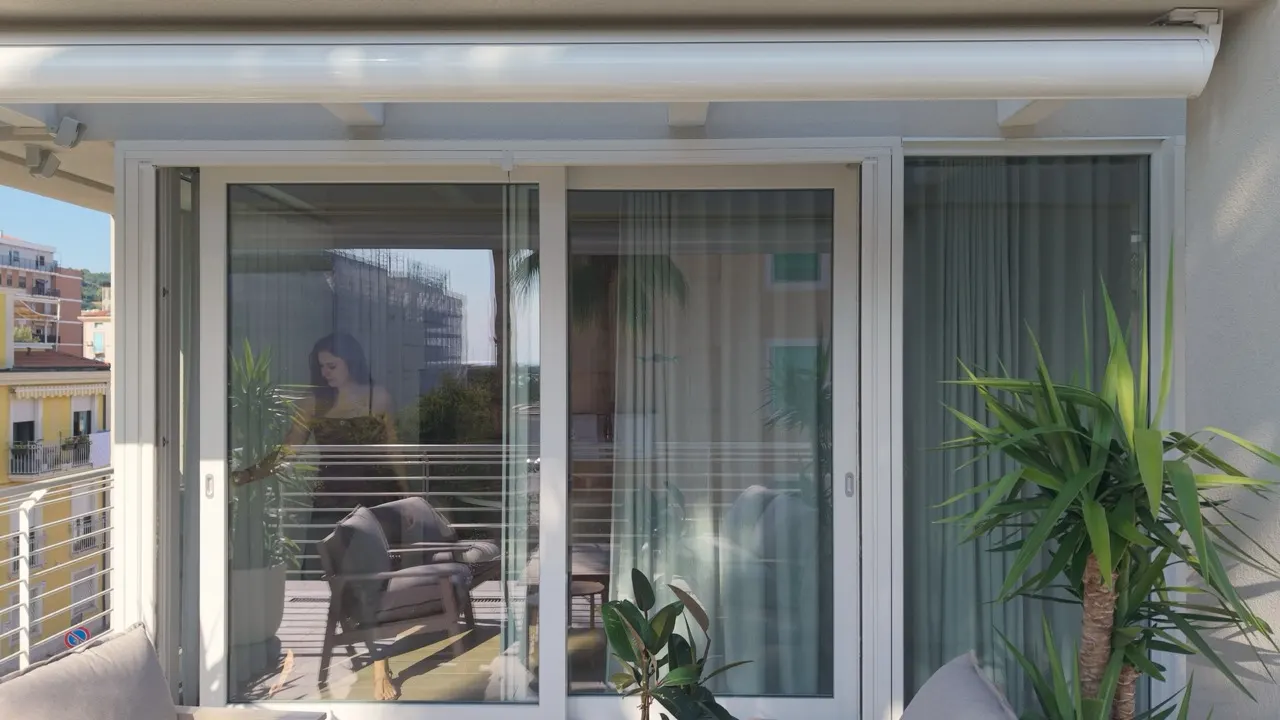
Sliding glazing opening onto a terrace

VEPA glazing

Panoramic glazing with no visible uprights

You close the porch when you need to and open it right up when the sun comes back. Toughened glass panes that slide and stack to one side. Free site visit between the Teramo coast and the Piceno area.

4,8 on Google, 30 reviews In Martinsicuro since 1990 Site visit and quote, both free

The moment you notice

The nicest part of the house gets used three months a year

From October the porch becomes a store: chairs stacked up, the table under a sheet.

Half an hour of wind and dinner outside is off, even when the temperature would allow it.

Rain blows in sideways, wets the wall and leaves marks on the floor.

Panoramic glazing encloses that space without taking away the reason you made it. They are toughened glass panes that run on a track and stack to one side: in winter they shelter, in summer they disappear into a corner.

Why panoramic glazing

Three things a large window does not do

Enclosing a porch with stacking glazing is a different matter from fitting a window into it. The starting idea changes.

01

No uprights in the middle of the view

Between one pane and the next there is no profile, the seal is made by gaskets flush with the glass. Sitting down you see the garden or the sea, not a grid of aluminium.

Track above and below, no vertical uprights
02

It opens all the way, not halfway

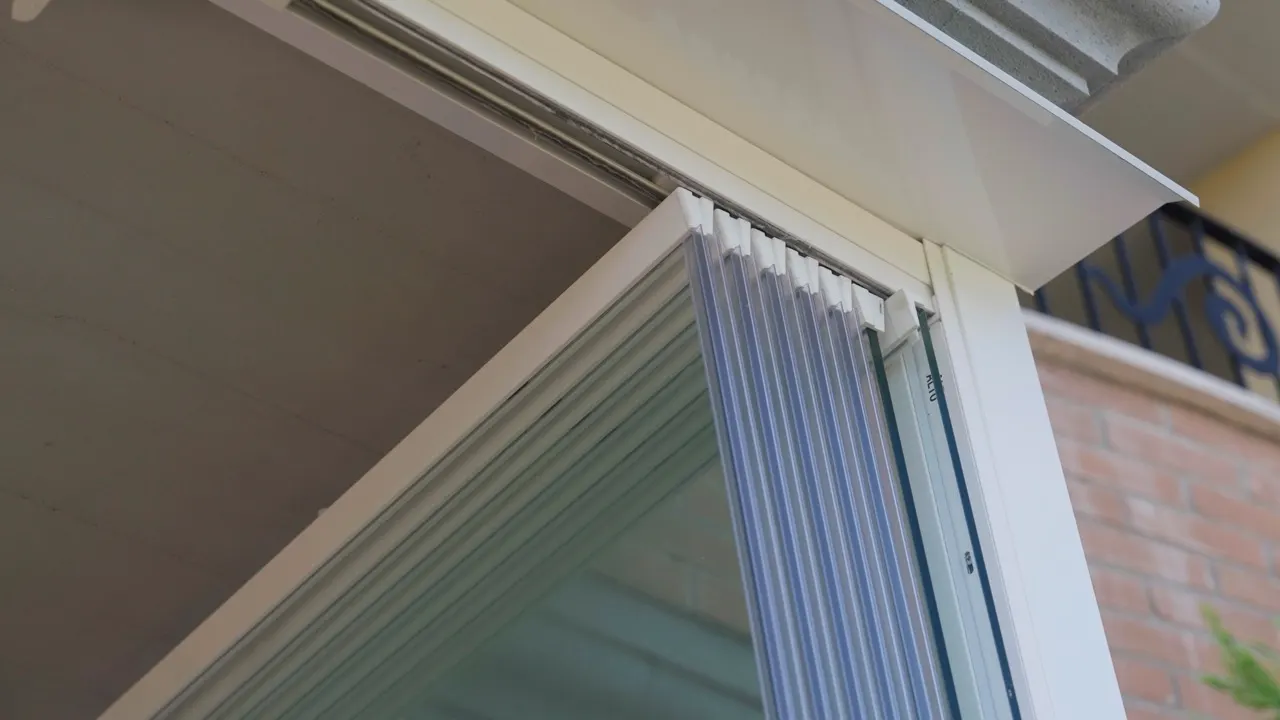
The panes slide right to the end, rotate and gather side by side against the wall. In a couple of minutes the opening is clear again, with nothing to dismantle.

Stacking to the right, to the left or on both sides

03

The outdoor space gets used eight months a year

With the wind stopped and the rain kept out, you can sit under the porch from March to November. It stays an outdoor space, but you stop using it only in summer.

Shelter from wind, driving rain, dust and leaves

How they are made

Glass, two tracks and no vertical profile

The system is simple, and that is why it works. Each pane is toughened glass, held by a slim profile above and below, and runs on a track. In between there is nothing: the panes sit side by side and it is the side gaskets that stop wind and water.

VEPA is the abbreviation Italian building rules use for exactly this glazing, panoramic and removable. To qualify it has to be completely transparent, with no masonry parts, in toughened or laminated glass, and it has to remain removable. That is the definition that keeps it distinct from a proper veranda.

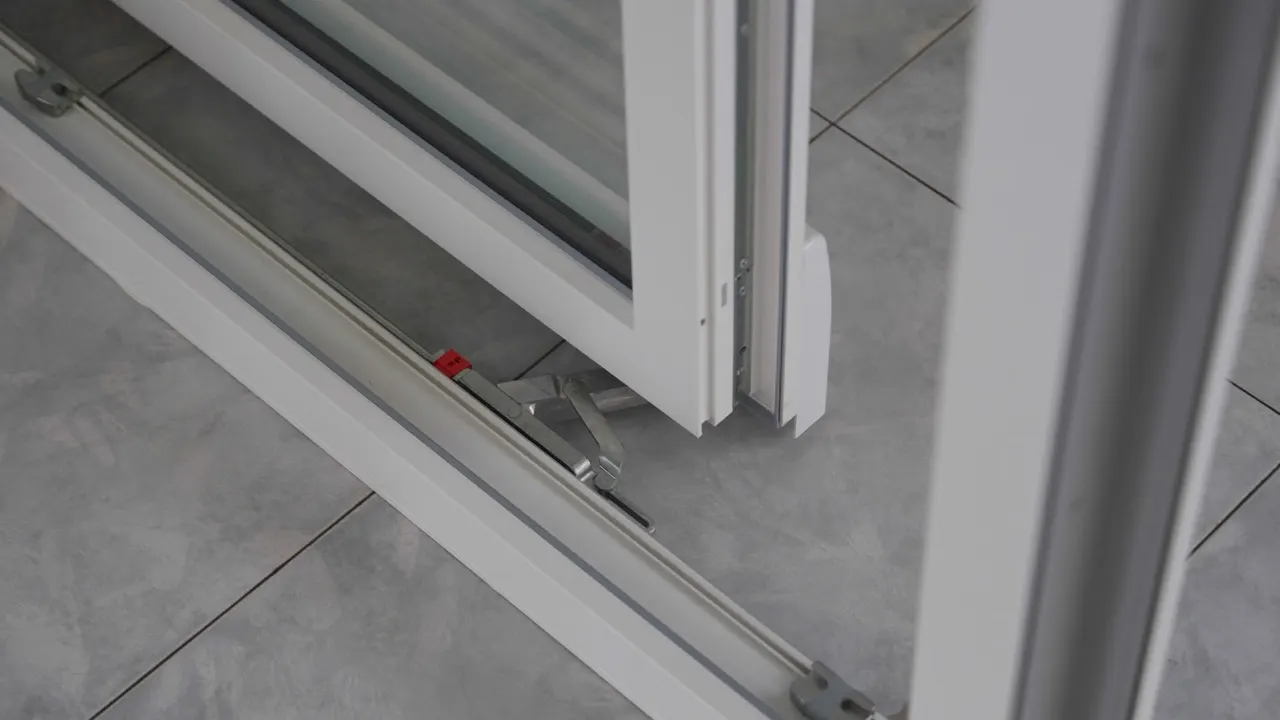
Floor track of a uPVC tilt-slide door
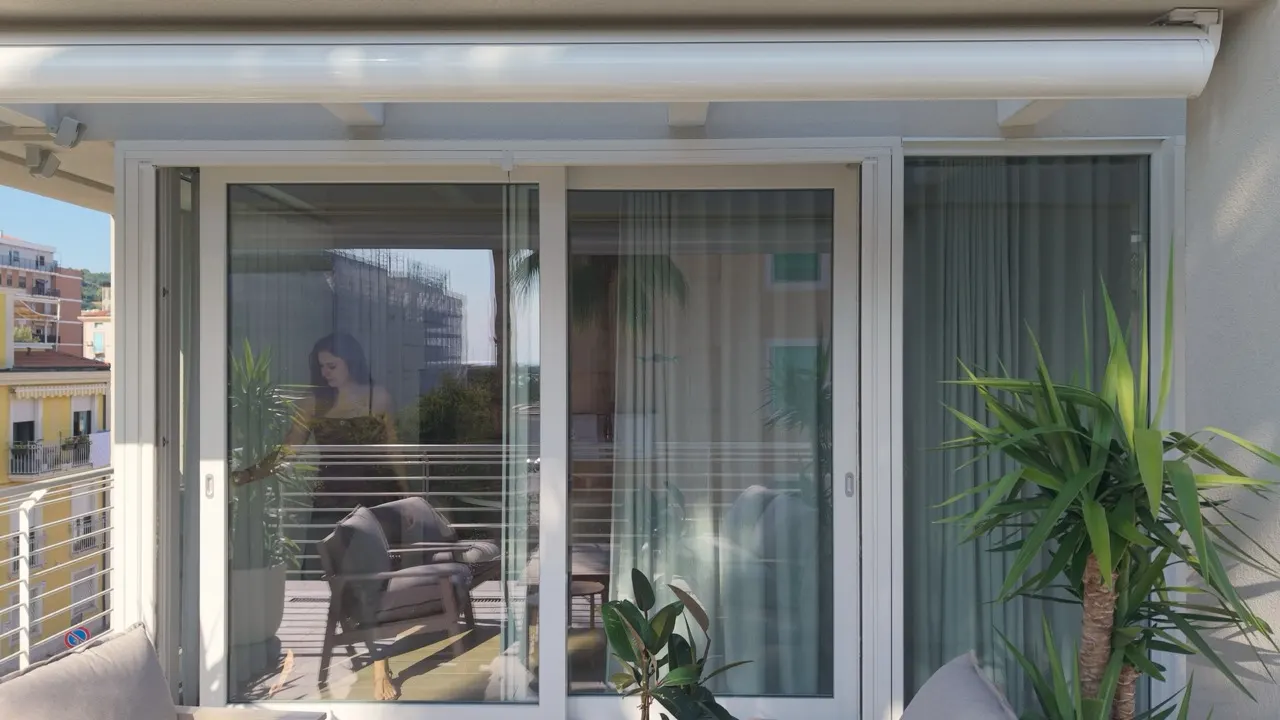
Panoramic glazing enclosing an outdoor space of a house

The installation

On a porch nothing is straight

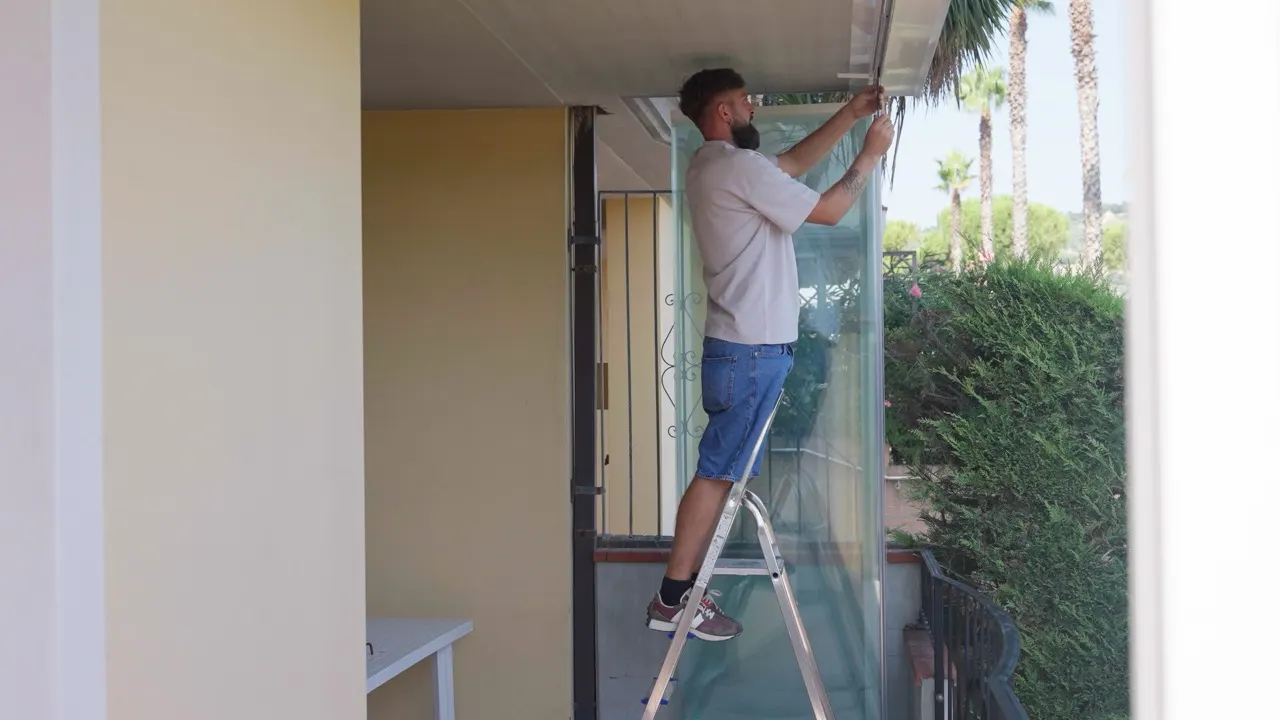
Pillars out of plumb, floors sloped to drain the water, lintels that drop a centimetre mid-span. Glazing with no uprights forgives little: if the track is not level the panes do not close. That is why we measure and we fit, and before we leave we run every pane in front of you.

The quote

What pushes the price up or down

There is no price per square metre that works for everyone, and anyone who gives you one over the phone without having seen the place is guessing. The same items always move the number. The span to cover, that is, how many metres of opening and how many panes are needed. The thickness of the glass, chosen according to the size of the single pane and how much wind that side takes. The type of glass, toughened or laminated, with or without solar control treatment.

Then there are the things you can only see on site. Where the panes end up when open, because stacking them needs a free stretch of wall. The state of the floor and the lintel, whether the track sits as it is or has to be prepared. The site visit is there to close down these variables before writing a figure, and the figure written then does not change.

Sliding panoramic glazing installed by Diva Infissi

Configurations

They do not all open the same way

The choice depends on how much space you have to one side to gather the panes and on how many times a year you think you will open everything up.

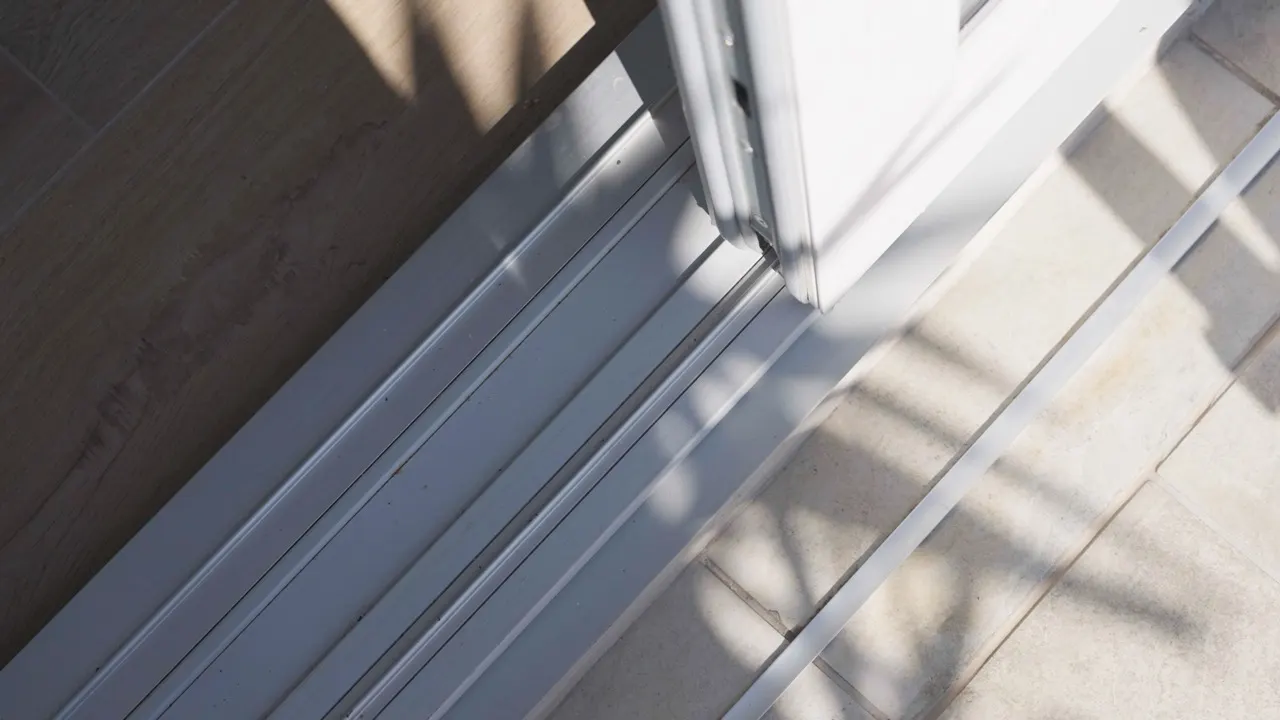
Floor guide of a glazed screen in raking light
Stacking The panes rotate and gather to one side: the opening is left completely clear.
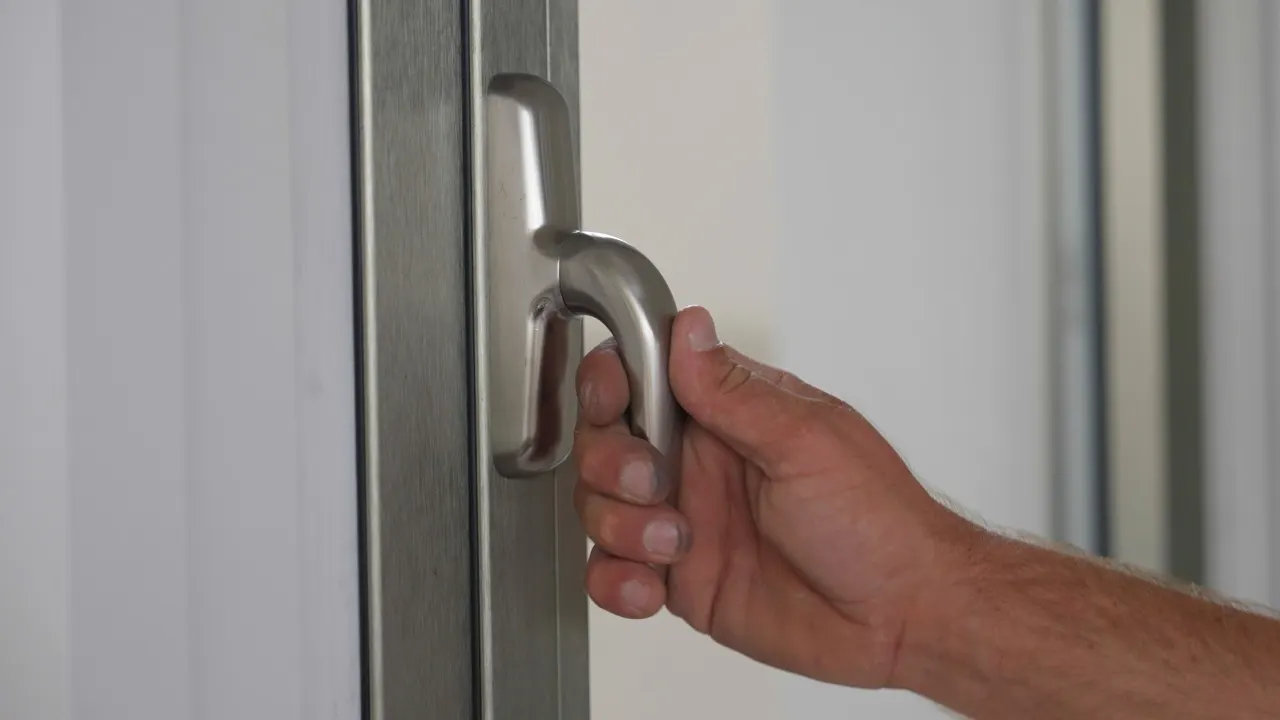
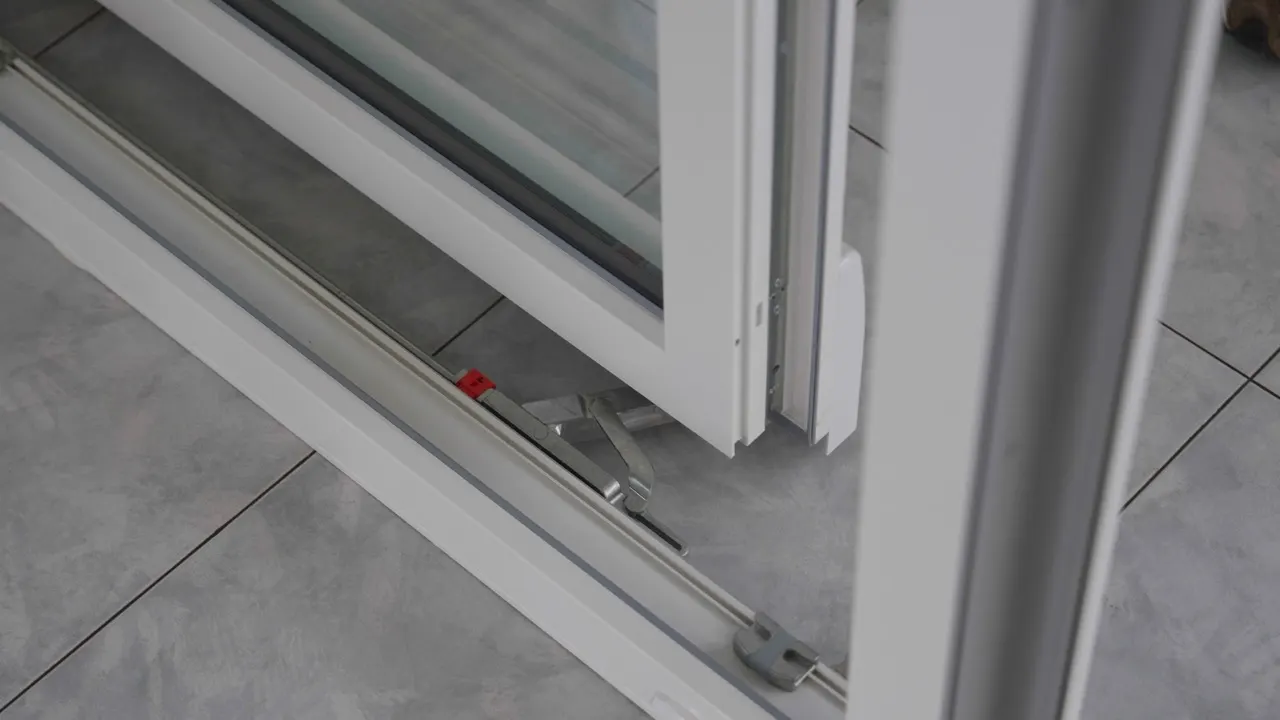
Sash of a uPVC tilt-slide door pulled ajar, with the hardware visible
Sliding The panes run on several tracks and overlap, taking up no space at the sides.
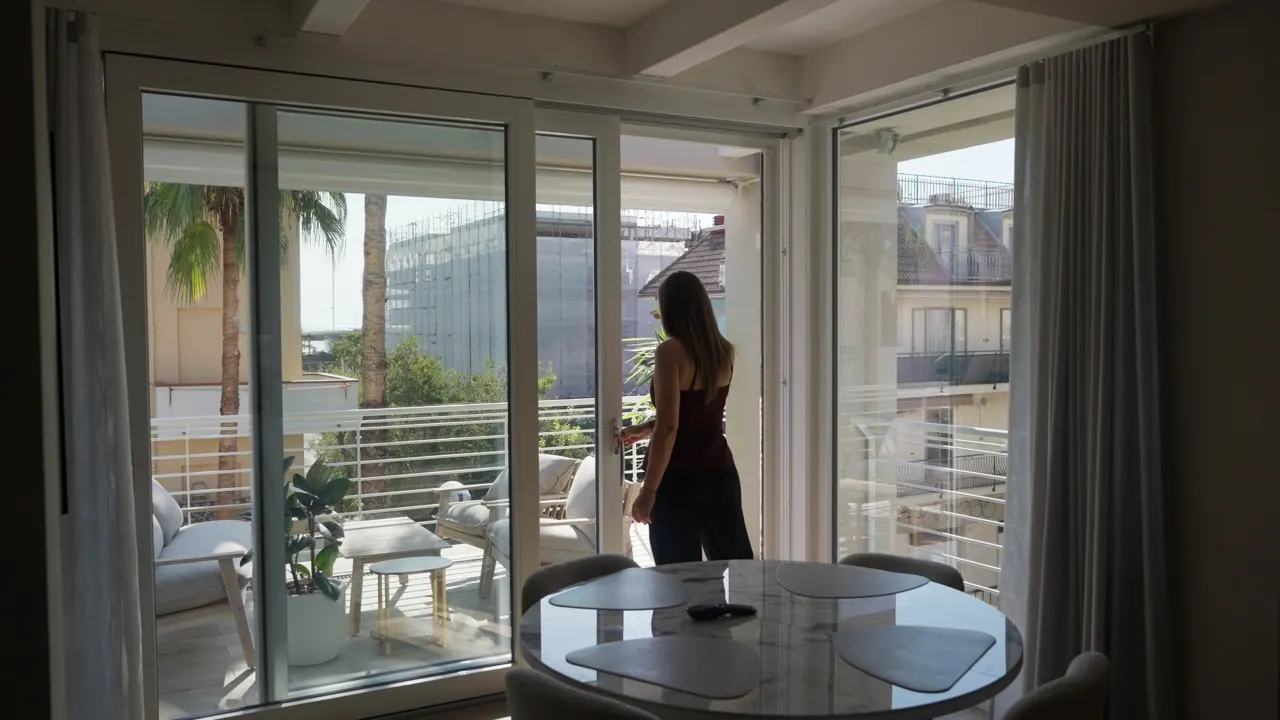
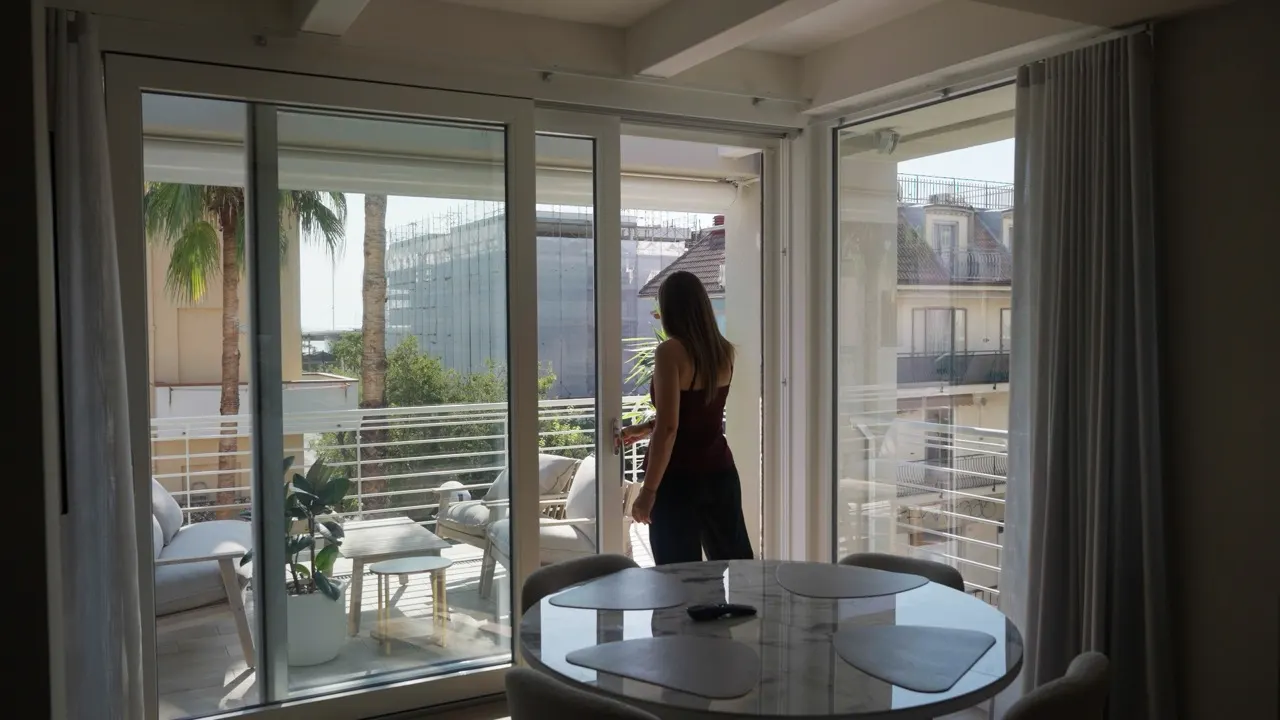
Glazing open on a balcony, seen from inside
With an access leaf The first pane opens like a door, to come and go without moving the others.

How we work

Four steps, no surprises

Free site visit

We come and look at the porch, measure the span and check the floor and the lintel. On an outdoor space, measurements taken by eye do not hold.

Written quote

Number of panes, thickness and type of glass, direction of stacking, tracks and fitting. Every item with its price.

Making and fitting

We prepare everything to measure and fit it ourselves. The work stays outside the house and we clean up at the end.

Final check and support

We open and close all the panes together. If a carriage needs adjusting over time, we come back.

Tax deduction

On VEPA glazing the deduction has to be looked at case by case

Here the word 'glazing' is not enough. Where the installation counts as extraordinary maintenance, the work may fall among those eligible under the building-recovery rules. The window ecobonus is another matter: it requires work on the envelope of a heated space, and a balcony enclosed with VEPA glazing normally is not one.

VEPAremovable panoramic glazing, the abbreviation you find in Italian law
Art. 6of the Italian Building Code, where they are defined
Case by casethe classification depends on the property and on how the work is done
How the tax credit works

Rates, ceilings and requirements change every year with the Italian budget law. On panoramic glazing the tax classification depends on the individual job: have your position confirmed by the surveyor or accountant handling the works.

Our work

Glazing we have fitted

Enclosures of porches, balconies and outdoor spaces between the coast and the Val Vibrata.

4,8 30 reviews on Google

People who have already enclosed their porch with us

Reviews published on the Diva Infissi Google listing, reproduced here in full.

The reviews are shown in Italian, exactly as they were written on Google. We do not translate what our customers said.

Roberto Picciuto 6 Giugno 2025

IL TOP, DI MEGLIO NON C'È, SUPER CONSIGLIATO, Qualità cortesia e prezzi giusti

Verified review on Google
Alexia Neziri 5 Giugno 2025

I migliori, hanno svolto un lavoro impeccabile, cordiali e precisi in tutto! Lavoro di qualità im tempi ottimali! Grazie davvero

Verified review on Google
Francesca D'Angelo 5 Giugno 2025

Esperienza e professionalità prodotti di ottima qualità. Consigliatissimo.

Verified review on Google
arturix 5 Giugno 2025

ottimo prodotto , prezzo giusto , persone cordiali e molto professionali nella scelta del prodotto e importantissimo presenti nel post vendita !consigliatissimi

Verified review on Google
Ilaria Vallese 5 Giugno 2025

Ho contattato la Diva Infissi per la sostituzione degli infissi di casa e sono rimasta molto soddisfatta. Il team è stato puntuale, professionale e preciso in ogni fase del lavoro, dal sopralluogo alla posa finale. I nuovi infissi sono di ottima qualità, hanno migliorato isolamento termico e acustico, e l’estetica della casa ne ha guadagnato. Un ringraziamento particolare al titolare sempre disponibile e attento alle richieste. Consiglio vivamente quest’azienda a chi cerca affidabilità, competenza e materiali di alto livello.

Verified review on Google

Why choose us

The questions you are asking yourself, and our answer

Who comes to fit it?

Our own fitters, not an outside crew. Whoever takes the measurements is whoever installs, and on glazing with no uprights that is the difference between panes that close and panes that touch.

Do I need a permit?

VEPA glazing falls under permit-free building work when it meets the requirements of Article 6 of the Italian Building Code. What still has to be checked are the building's own rules, the council's building regulations and any landscape restrictions, which are not rare on the coast. We tell you what to check before ordering.

Can the price change along the way?

No. After the site visit the quote is the quote. If the floor or the lintel have to be prepared we find that out beforehand, not once fitting has started.

Can I see them in person?

Yes, at Via dell'Industria 10 in Martinsicuro. A pane that rotates and stacks has to be seen with your hands; catalogues do not explain it.

And if a pane runs badly a year from now?

We come back and adjust it. We have been in Martinsicuro since 1990 and the porches we have worked on are right around here: we do not disappear once the invoice is paid.

Do you do the rest of the outdoor space too?

Yes: awnings, insect screens, shutters and the full enclosure of balconies and verandas when a proper window system is needed. One person to deal with for everything outdoors.

Frequent questions

What people considering glazing ask

These are the questions that come up most often, on the phone and on Google.

What is removable panoramic glazing?

It is VEPA glazing: glass walls that enclose projecting balconies, loggias and porches recessed into the building, and that can be opened and removed. They are defined by Article 6 of the Italian Building Code, Presidential Decree 380/2001, which under certain conditions puts them within permit-free building work.

The conditions are precise: completely transparent, with no masonry parts, in toughened or laminated glass, removable, with a profile that does not alter the lines of the building. The heaviest condition is the last one: they must not create a permanently enclosed space, so no new volume and no change of use. If the space becomes a room to all intents and purposes, it is no longer VEPA glazing and you are into different paperwork.

What are the drawbacks of panoramic glazing?

The first is also the most misunderstood: they are single glazed, not double glazed. They stop wind, rain and dust, but they do not insulate like a window, and condensation forms on cold glass. Anyone buying them expecting an extra room will be disappointed.

The second is the seal: the gaskets between one pane and the next are effective, but they are not hermetic. With driving rain and strong wind a few drops can get through the joints. Then there is the sun: a glass wall facing south, with no shading, heats up a good deal in summer.

How much do panoramic glazing systems insulate?

Far less than a window, far more than nothing. The real step change is the wind: stopping moving air is what changes the perceived temperature, and on a day of north wind the difference between an open and an enclosed porch is felt immediately.

In numbers, though, the glass is single and toughened, with no cavity and no gas: the thermal transmittance is a long way from low-emissivity double glazing. The space stays warmer than outside and sheltered, but it is not an insulated room and should not be treated as one.

When does panoramic glazing qualify for the tax deduction?

It depends on how the work is classified, not on the product. The fact that VEPA glazing falls under permit-free building work does not in itself rule out the relief: for permit-free works the Italian Revenue Agency asks for a statutory declaration with the start date of the works and a statement that the work is among those eligible. What counts is whether the work amounts to extraordinary maintenance on the property.

The window ecobonus is a different matter: it presupposes work on the envelope of a heated space with an improvement in thermal transmittance, and a balcony or porch enclosed with VEPA glazing is normally not a heated space, so that route does not hold. Before signing, have your case assessed by an accountant or a surveyor: on panoramic glazing the classification is the delicate part.

How do you shade panoramic glazing?

From inside with roller blinds or venetian blinds fixed to the lintel, from outside with an awning or a pergola that intercepts the sun before it hits the glass. The second solution is more effective, because you stop the heat outside instead of finding it inside.

One thing to watch: the rules on VEPA glazing require it to be completely transparent. Frosted or screen-printed glass and opaque films can make that requirement fail. If you need privacy, it is better to solve it with removable shading than with the glass.

How do you heat a space enclosed with panoramic glazing?

With radiant heat, not by heating the air. Infrared lamps or outdoor radiant heaters warm people and surfaces and work even in an uninsulated space, where a fan heater works for nothing because the heat goes out through the single glazing.

A practical warning: taking the house heating system out there is what must not be done. A balcony or porch permanently heated becomes habitable volume to all intents and purposes, and that is exactly the condition the VEPA rules do not allow.

How do you clean panoramic glazing?

The glass with water and a neutral detergent and a soft cloth, no abrasives and no scrapers. In stacking systems the panes rotate on themselves, so you can clean the outer face while staying inside.

The maintenance that really counts, though, is another: the bottom track. Sand, leaves and dust settle there and are the number one cause of panes that run badly. Go over it with the vacuum cleaner now and then and brush the vertical gaskets. A couple of times a year a spray lubricant on the carriages keeps the system smooth.

How much does panoramic glazing cost per square metre?

The square metre is a misleading measure here. Two enclosures of the same area can cost very different amounts: a long, low one needs more panes and more metres of track than a tall, narrow one, and above a certain size of single pane the glass thickness has to go up, with weight and hardware going up accordingly.

The price is driven by the number of panes, thickness and type of glass, the direction of opening, the length of the tracks and the preparation of the floor and the lintel. That is why we come and measure first: after the site visit you get the price written item by item, and it does not change.

What is the difference between sliding and stacking panoramic glazing?

In sliding systems the panes run on several parallel tracks and overlap one behind the other. No space is needed at the sides, but the opening reaches at most half or two thirds of the span, because part of it always stays covered.

In stacking systems the panes run on a single track, reach the end, rotate ninety degrees and gather into a pack against the wall. The opening is left almost entirely clear, but you need a stretch of wall or a free space to park the pack. If you really want the porch open in summer, that is the route.

Can panoramic glazing go on a balcony?

Yes, and it is the most common case. The rules expressly mention balconies projecting from the body of the building and recessed loggias: the glazing starts from the existing balustrade and closes the upper part, or comes down to floor level where the balustrade is glass or is kept.

In a block of flats there are two extra steps before ordering: the building's own rules and the architectural character of the facade. If the building already has other enclosures of the same kind the route is easier; if you are the first it is worth going through the owners' meeting. And if there is a landscape restriction, authorisation is needed, which does happen along the coast.

Let us start

Six questions and we already know what we are talking about

It takes under a minute to answer, and rough measurements are fine. We call you back within 24 working hours to arrange the free site visit.

  • Free site visit and quote, with no obligation
  • The price written down is the final one
  • Attach a photo of the porch and the estimate gets more accurate
  • We measure and fit ourselves, in Martinsicuro since 1990

Or call 328 329 5757
Mon - Fri 08:00 - 12:15 / 14:00 - 18:15

Call WhatsApp Get a quote